"NASA Confirms Water Found on Distant Exoplanet"
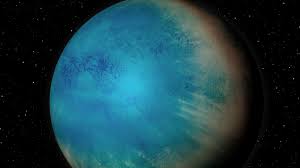
NASA Confirms Water Found on Distant Exoplanet
In a groundbreaking astronomical discovery, NASA has confirmed the presence of water vapor in the atmosphere of a distant exoplanet, sparking excitement and renewed hope in the search for extraterrestrial life. The planet, located more than 100 light-years from Earth in the habitable zone of its star, is now considered one of the most promising candidates for potential life beyond our solar system.
The discovery was made using data from the James Webb Space Telescope (JWST), which detected signatures of water molecules during a detailed atmospheric analysis. The exoplanet, officially named K2-18b, orbits a red dwarf star in the Leo constellation and has long intrigued astronomers due to its Earth-like size and orbital distance—ideal conditions for liquid water to exist on its surface or within its atmosphere.
What sets this discovery apart is not just the detection of water, but the combination of favorable environmental factors that make K2-18b uniquely positioned as a potential “second Earth.” The atmosphere also contains hydrogen, methane, and carbon dioxide—key ingredients that, when found together, increase the probability of habitability.
“This is the most compelling evidence we’ve found so far that an exoplanet outside our solar system might support life as we know it,” said Dr. Elena Ramirez, a leading exoplanet researcher at NASA. “Water is essential for life, and the fact that we’ve detected it on a planet within the habitable zone is truly extraordinary.”
The detection of water vapor was made possible through a technique known as transit spectroscopy, where scientists observe the way starlight filters through a planet’s atmosphere as it passes in front of its host star. This method allows researchers to identify the chemical makeup of the atmosphere based on how different molecules absorb light.
Although K2-18b is not identical to Earth—it is roughly 2.6 times larger and may have a thick, hydrogen-rich atmosphere—the findings raise fascinating questions about the variety of potentially life-supporting worlds in the galaxy. Some scientists speculate that the planet could host a liquid water ocean beneath its gaseous layers, possibly providing an environment similar to Earth’s deep ocean ecosystems.